Best Garage Floor Epoxy Coatings: Honest Reviews
Searching for epoxy coating reviews usually means one thing: you’ve seen the options, you’re overwhelmed, and you want someone to cut through the marketing. Here’s what actually matters — adhesion, durability, ease of application, and whether a product delivers on its coverage claims.
How We Evaluated These Products
Every product below was assessed on four criteria: bond strength to concrete, resistance to hot tire pickup, chemical and stain resistance, and real-world application difficulty. A coating can look great on day one and fail inside two winters if the formula is wrong or the prep requirements are unrealistic for a DIYer.
Coverage claims on buckets are almost always optimistic. Thin coats on porous concrete are the number-one reason coatings peel.
Top Pick: Rust-Oleum EpoxyShield 2-Part Garage Floor Coating
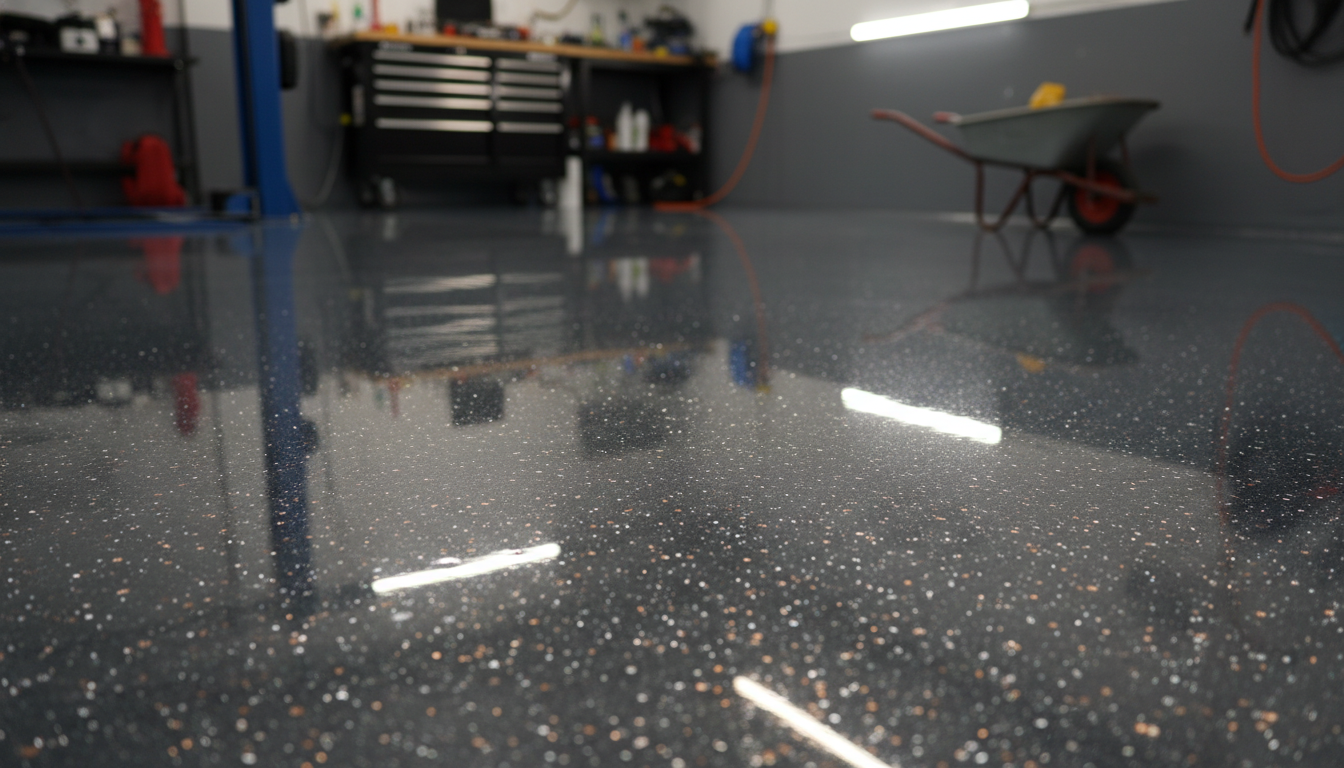
Rust-Oleum EpoxyShield 2-Part Garage Floor Coating remains the most accessible high-quality option for most homeowners. The two-part water-based epoxy covers roughly 250 sq ft per kit, it includes a concrete etching solution, and the color chip system hides minor imperfections well.
Hot tire pickup resistance is solid but not exceptional. If you’re parking a car that sits in the sun before pulling into the garage, expect some minor surface marring after a few summers. For light-to-moderate vehicle traffic it’s a reliable performer.
Application is forgiving. The pot life is around two hours, giving you enough time to work a two-car garage in sections without rushing. Surface prep is still critical — skip the acid etch and you’ll see peeling within a year.
Runner-Up: Armor Garage Epoxy Floor Kit
Armor Garage Epoxy Floor Kit steps up noticeably in solids content — their standard kit runs around 47% solids versus the roughly 40% you get from most box-store options. Higher solids means a thicker, harder cured film.
The trade-off is application difficulty. The pot life is shorter, the material is thicker, and you need to work faster and more methodically. First-time DIYers sometimes struggle with roller marks or lap lines. Read their surface prep guide in full before you start — they’re specific about moisture vapor emission requirements.
Coverage is rated at 200–250 sq ft per kit, which is more honest than most brands. The finished surface handles chemical spills (oil, brake fluid, mild solvents) better than water-based options.
Budget Option: KILZ 1-Part Epoxy Acrylic Interior/Exterior Floor Paint
KILZ 1-Part Epoxy Acrylic Floor Paint isn’t a true two-part epoxy — calling it “epoxy” is a marketing stretch. It’s a latex floor paint with epoxy additives. That said, it’s easy to apply, requires minimal surface prep, and costs a fraction of real epoxy systems.
Expect it to scratch and scuff more than a two-part system. It’s a reasonable choice for a utility storage garage or workshop with foot traffic only. Don’t use it in a bay where vehicles are regularly driven in and parked.
One coat covers roughly 400 sq ft. Apply two coats for any real durability. Full cure takes about 30 days before you should park on it.
Premium Pick: Penntek Polyurea Garage Floor Coating
Penntek Polyurea Garage Floor Coating is technically a polyurea, not epoxy, but it’s the category most serious buyers compare against top epoxy systems. Polyurea cures faster, is more UV stable (no yellowing), and handles hot tire pickup better than any standard epoxy.
The cost is higher, and the application window is aggressive — some formulas have a pot life under 20 minutes. This isn’t a product for first-timers working alone. Many homeowners buy the Penntek system and hire a pro for the pour and roll.
If you want a floor that looks showroom-quality after five years, polyurea is the direction to go. If you want something you can apply yourself on a Saturday, stick with EpoxyShield or Armor Garage.
What Actually Causes Coatings to Fail
Most failures come down to three things: inadequate surface prep, application over a damp or contaminated slab, and skipping a topcoat.
- Surface prep: Acid etching or mechanical grinding opens the concrete pores. Without it, adhesion is mechanical luck.
- Moisture: A simple plastic sheet test — tape a 2-ft square of plastic to the floor overnight. Condensation underneath means moisture vapor is present. Most standard epoxies will fail on slabs with high MVT.
- No topcoat: A colored basecoat without a clear polyurethane or polyaspartic topcoat will scuff, stain, and chalk out within two to three years.
Rust-Oleum EpoxyShield Clear Topcoat pairs well with their base system and adds meaningful protection for under $40.
Bottom line: For most DIYers, Rust-Oleum EpoxyShield is the right starting point — widely available, forgiving to apply, and durable enough for normal garage use. Step up to Armor Garage if you want higher solids and better chemical resistance. Go polyurea only if you’re willing to pay more or hire a professional.
Where to buy
- Rust-Oleum EpoxyShield 2-Part Garage Floor Coating
- Armor Garage Epoxy Floor Kit
- KILZ 1-Part Epoxy Acrylic Floor Paint
- Penntek Polyurea Garage Floor Coating
- Rust-Oleum EpoxyShield Clear Topcoat